Be yourself; Everyone else is already taken.
— Oscar Wilde.
This is the first post on my new blog. I’m just getting this new blog going, so stay tuned for more. Subscribe below to get notified when I post new updates.
Be yourself; Everyone else is already taken.
— Oscar Wilde.
This is the first post on my new blog. I’m just getting this new blog going, so stay tuned for more. Subscribe below to get notified when I post new updates.
Don’t you just hate it when you suddenly find out that you’re the long lost daughter of the richest CEO in the country? Or when you shockingly discover that you have a twin sibling whose lifestyle is the complete opposite of yours? Or better yet, when someone you thought was dead is actually alive, only looking drastically different from their past self? I could go on and on with the list of cliche drama tropes. If you’re a Filipino, there’s a big chance that you’ve watched at least one soap opera with a crazy cliche plot line within the entire course of your life. Plus points if it has the queen of soap opera Judy Ann Santos or Maja Salvador starring as a feisty mean girl. Or Janice de Belen starring as the protagonist’s mother and Albert Martinez starring as a character’s dad. Plus plus points if there are never-ending plot twists, or if the plot twist happens just as the series ends. Over the years, telenovelas have become a huge part of the daily life of the average Pinoy.
The earliest memory I have of watching a soap opera was when I was a toddler. It was back in 2007. I was 6 years old then, or maybe 7? I remember going downstairs late at night and I would see our housekeepers propped on the couch, intently watching and getting sucked in on the television. On some nights it was probably a third party confronting the real wife with the cheating husband standing in the back, with them expressing their frustration and anger towards the mistress. On other nights it was something light like a romantic comedy, and they would get all kilig and shout out of excitement over what was happening, or maybe still get frustrated over some love triangle. I couldn’t really remember what was going on, but I remember joining them. I’d disturb and try to get the attention of my Ate Baby, only to get shushed. “Tsk! Wag makulit, nanonood ako,” they’d say to me.
Another one was when GMA Network’s Super Twins was airing in 2007, and my cousin and I were super obsessed with it. We loved it so much that whenever I went over to their place, we’d walk around the neighborhood and pretend to be them. I’d be the blue one (Super S) and she’d be the orange one (Super T), then we’d run around with arms out shouting whatever line they’d always say whenever they transformed.
The presence of telenovelas in my life didn’t stop there. Even as I went into adolescence, I was still very much exposed to the dramatic world of Filipino soap operas. I remember back then when the 2010 remake of Mara Clara started airing. I was in 3rd grade and very much invested. I’d impatiently wait in front of the television, waiting for TV Patrol to conclude, because the end of the night time report means the start of the evening soaps. I vividly remember the anger and irritation I felt towards Julia Montes’ character Clara whenever she’d bully Mara (Kathryn Bernardo), as well as the intense revelation of the birth switch between Mara and Clara. I wasn’t alone in this obsession with the said series. Every after an episode ends, I’d be excited to come to school the next day just to make chika about what happened during last night’s episode. We’d vent out our frustrations towards a certain character, or maybe fangirl about Albie Casino or Diego Loyzaga, Kathryn Bernardo’s then love triangle.
The addiction didn’t stop with Mara Clara. The following year, there was Agua Bendita, where I became addicted to photoshopping (by photoshop, I meant the iconic pizap) myself a twin sister that’s made of water. There was also May Bukas Pa, where Santino said bro way before the conyo kids did. But how did this telenovela culture exactly start?
Though not exactly a drama, the earliest forms of Philippine drama can be traced back to pre-Spanish colonization. One of which was Duplo, a poetic debate where a “king” throws an accusation and the participants have to defend themselves in dodecasyllabic quatrains full of figures of speech or accuse someone else. The goal was to keep the verses flowing like a rap battle until a player is found guilty.
However, Philippine Drama is said to be a result of colonialism, and first started in the form of theater. According to Doreen G. Fernandez (1980), Philippine Theater is heavily derived from Spanish Theater, and that it was claimed to be non-existent before the Spanish Occupation. The first dramatizations in the Philippines were religious in context. The first ever drama recorded was a Comedia written by Vicente Puche, and was performed in honor of Cebu’s first bishop Msgr. Pedro de Agurto. There were three kinds of plays introduced to us by the Spaniards: Senakulo, a heavy drama depicting the life and sacrifices of Jesus Christ. Moro-moro, a play depicting the war between Christians and Muslims, with Christians always winning. Lastly, the Zarzuela, a melodrama containing songs and dances.
But soap opera didn’t enter the Philippine entertainment industry until 1949, when Gulong ng Palad (Wheel of Fortune) started airing on the radio. It was first aired by radio station DZRH and lasted until 1956. It was later adapted into a television series in 1977. Soap operas stayed on radio up until the 60s, when it started expanding into television. The first ever TV soap opera in the Philippines was aired in 1963 entitled Hiwaga sa Bahay na Bato, and was produced by ABS-CBN.
Things changed when the 90s came and the new wave of Mexican dramas sweeped Filipinos right off their feet. Mexican television dramas started to be imported in the country, dubbing the series in Filipino, most of which was aired by ABS-CBN. The most notable drama in the decade was Marimar, which entered Philippine television in the year 1996. It was aired by the then government-owned station RPN-9 and topped the ratings chart. This prompted changes in Philippine television as programs in the future continued to translate and dub a variety of dramas. In 2007, a Filipino remake of Marimar was broadcasted by GMA Network, starring Marian Rivera.
The term teleserye started in the 2000s when modern Philippine television started to evolve into its own form, combining the words telebisyon (television) and serye (series). It came from the drama Pangako Sa’ Yo, which was named as the country’s first ever teleserye, aired by ABS-CBN. It was also deemed as one of the most significant turning points in the history of Philippine television considering its developed production, fast pacing, and complex story structure, which was something that was never seen in the dramas prior. It was so successful it aired internationally across Asia, Africa, and America and became the highest rated teleserye in the history of Philippine television. By the time 2010s came, ABS-CBN and GMA Network were head-to-head when it came to the most watched network in the Philippines and were considered to be rivals.
These telenovelas are mostly given a specific time slot, usually airing during prime time, between 8pm to 11pm when the audience is expected to be the most. Usually, new episodes are released every weekday and often last for a span of 3 months, depending on the viewer ratings of the show. If a show’s popularity skyrockets, it can possibly last for a year or more. A good example for this is the television remake of FPJ’s Ang Probinsyano, which now has been airing for 5 years due to popular demand. But what makes a telenovela, a telenovela? There must be some recipe to it that makes it appeal to the Filipino crowd.
Soap operas in the Philippines share similarities to the ones abroad. There were even remakes of the ones imported from other countries, after all. More often than not, these dramas tend to be exaggerated to enhance the impact, excitement, and suspense on the audience. Melodramatic content is a big part of Filipino soap operas. This can be observed through the numerous plot twists and big secret reveals shows often utilize as a way of entertaining and keeping the audience on their toes. These melodramatic devices shows make use of have been repeatedly done over the years that it now tends to be a cliche when it does happen.
The melodramatic aspect of dramas can often be observed through the numerous coincidences and the shocking revelations usually revealed by the end of the show. Some common plot devices used (or more like overly-used) are as follows, but not limited to: birth-switching, rich girl/poor guy romance, main character goes through amnesia, and the third party among others. But no matter how cliche the plotline gets, people still get so invested in the show. I call this a guilty pleasure.
Another characteristic that can be observed in these soap operas is the emphasis of glamour through the settings and presentations used. More often than not, there is a character that represents a rich person, who is also usually the antagonist of the show. A classic example of this is Pangako Sa ‘Yo’s, Amor Powers, who carries herself with a glamorous atmosphere through her impeccable makeup and businesslike but extravagant clothing. Another example of this is Margaux Marasigan, played by Maja Salvador, who is the heiress of a famous shoe company called Memorata in the soap opera Ina, Kapatid, Anak.
Philippines telenovelas could be considered as a reflection of reality in the Philippine society considering its social realist content, especially if you observe the common denominators between the portrayal of the characters and people in real life. One could tell a lot about Philippine culture, stereotypes, current issues, attitudes, etc. just by watching a Philippine telenovela, especially since these dramas often fall under the genre of slice-of-life and are always set in the Filipino context.
For instance, the hierarchy in social classes are always clearly stated or portrayed in telenovelas. A common feature between the poor protagonists across soap operas is that they always get blamed for the crimes or wrongdoings done by the rich antagonists. This is similar to the reality of the Philippines, where a lot of establishments are anti-poor, and to be poor in the Philippines might as well be a crime. However, the poor protagonists always fight back and show resistance to the oppression they experience, with them usually winning and getting justice in the end through their own happy ending. Filipinos have shown to like this aspect of telenovelas, often rooting for the protagonist to prevail.
This preference could be a symbolic reflection of the reality the viewers actually face, finding consolation in the fairytale-like endings of the shows. However, the influence of telenovelas doesn’t stop there. This form of art could also be used as a means to revolt against the issues the country is currently facing. Since Philippine telenovelas usually target the masses, this would be effective in spreading awareness and promoting advocacy. Proper representation in Filipino soap operas can influence a viewer’s point of view and perception.
On a larger scale, the popularity of Filipino soap operas has grown since the 2000s, even reaching an international audience. It became popular in continents like Asia and Africa, and has appealed to overseas Filipinos in North America as well.
With that, it is no question that telenovelas have had a big impact on the Filipino people. People are able to bond and form relationships because of telenovelas as these are part of the lives of every ordinary Filipino. In parlors, carinderias, and the drivers’ waiting shed, a telenovela is always being broadcasted, and the people would chit-chat about the dilemmas and happenings in a telenovela character’s life. The fact that these are relatable or suspenseful is very effective in forming topics among groups of people.
Even until today, telenovelas have continued to be an active part in the daily lives of Filipinos, including myself. There was this scene from a GMA telenovela called Ika-6 na Utos that went viral on Twitter a few years ago. Basically, the scene was about two pregnant women (who were, unsurprisingly, enemies) shopping for a stroller, but accidentally pick the same exact one. In true telenovela fashion, a cat fight broke out. What made the scene trend was the fact that the two women grabbed a toy gun and pointed it at each other while fighting. My friend, who is very much into soap operas, asked me to recreate the scene with her. And I did. Which was entertaining, for the most part, although embarrassing.
That same friend is also the same one who updates me with the latest telenovelas going on right now. The most popular one that she always obsessed over was the recently concluded Kadenang Ginto, starring the teen stars Andrea Brillantes and Francine Diaz. Basically, it was about the family drama of the Mondragons, with the usual third party and unknown child plotline. Though cliche and expected, the show hit the top ratings and was said to be high quality.
Even as decades pass by, the feeling of going downstairs to the living room and seeing whoever is home, be it your ates or your lola or your nanay, focusing on the television and watching intently as Angel Locsin and Maja Salvador confront each other in The Legal Wife: The Royal Rumble. Getting sucked in as you watch Angel Locsin’s character Monica repeatedly slap and insult Maja Salvador’s character Nicole, who is both her best friend and mistress of her husband.
Or scrolling across the television looking for a channel to watch a show, coming across ABS-CBN or GMA Network with a dramatic scene playing. Staying on the channel because it looks entertaining, but actually getting invested in it minutes later. Maybe a scene with Julia Montes screaming (non-verbatim) “I am the real daughter! Ako ang tunay na anak!” as they reveal that Kathryn Bernardo is actually the real daughter, and that they were actually switched at birth. Or maybe it was just a scene with a random girl throwing water at another girl’s face.
From Gretchen Barretto’s “You want war, I’ll give you war. Sabihin mo lang kung saan at kailan, I’ll be there in my red stilettos!”, Maja Salvador’s “Pagluksaan man kayo ng iba pero kayo hinding hindi ko kayo pagluluksaan. Kaya nga hindi ako nakaitim, ’cause black is out, gold is in! Yes, just like gold, I am indestructible!”, and Jodi Sta. Maria’s “Matitikman niyo ang batas ng isang api!”. These iconic lines and memorable scenes are what made Filipino telenovelas what it is today. Even until today, the current soap operas being aired continue to be as good, if not as iconic. Over the years, Filipino dramas have evolved through its improving production and complex storylines, but still containing the true essence of a classic telenovela. Although corny and cheesy at most times, the clicheness and melodramatic nature of a Pinoy telenovela will never die and will forever be embedded within the country’s pop culture.
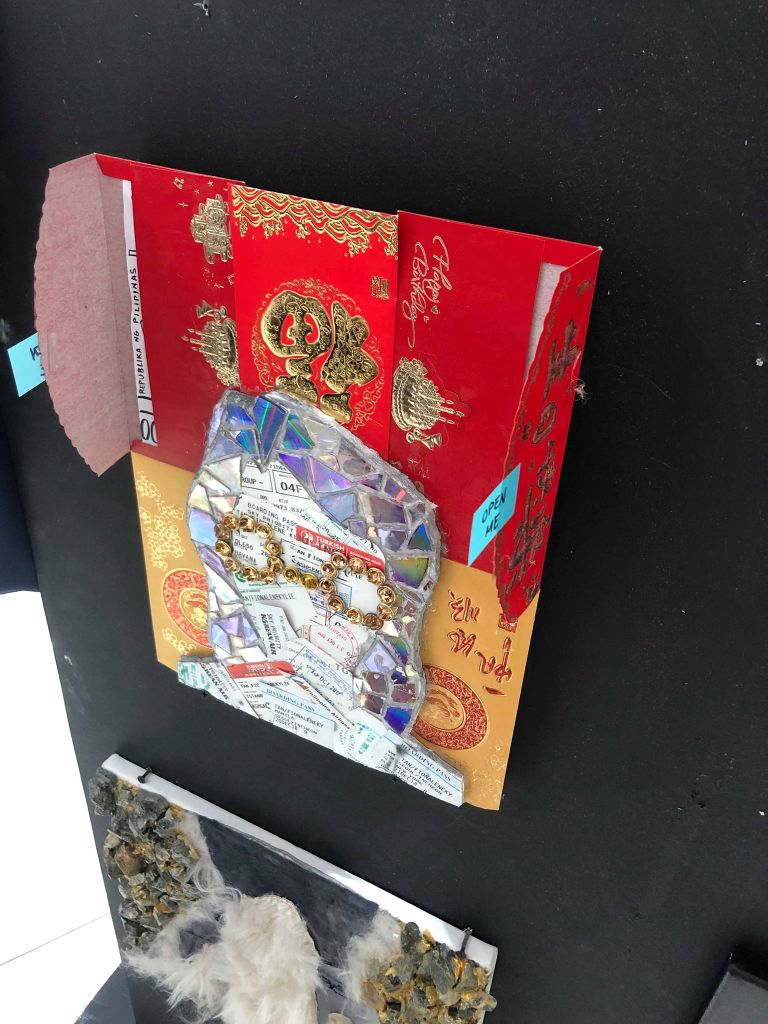
“What we consume is directly related to our identity,” said Ms. Mariko, the organizer of the art exhibit entitled Bagay-bagay during our question and answer. And it’s true, isn’t it? Come to think of it, we often don’t realize how the bits and pieces of things that we consume on a daily or on a regular basis slowly slowly become ingrained in how we identify ourselves. I’m not saying that it entirely becomes who we are as a person, but rather it becomes part of our identity. It’s like how people who love to read identify as bookworms, or how people who “stan” a particular group are part of fandoms. And what’s more interesting is that we are not just limited to one piece of media for us to consume. We can take part in different activities and pursue our various interests, and slowly it all builds up to who we are.
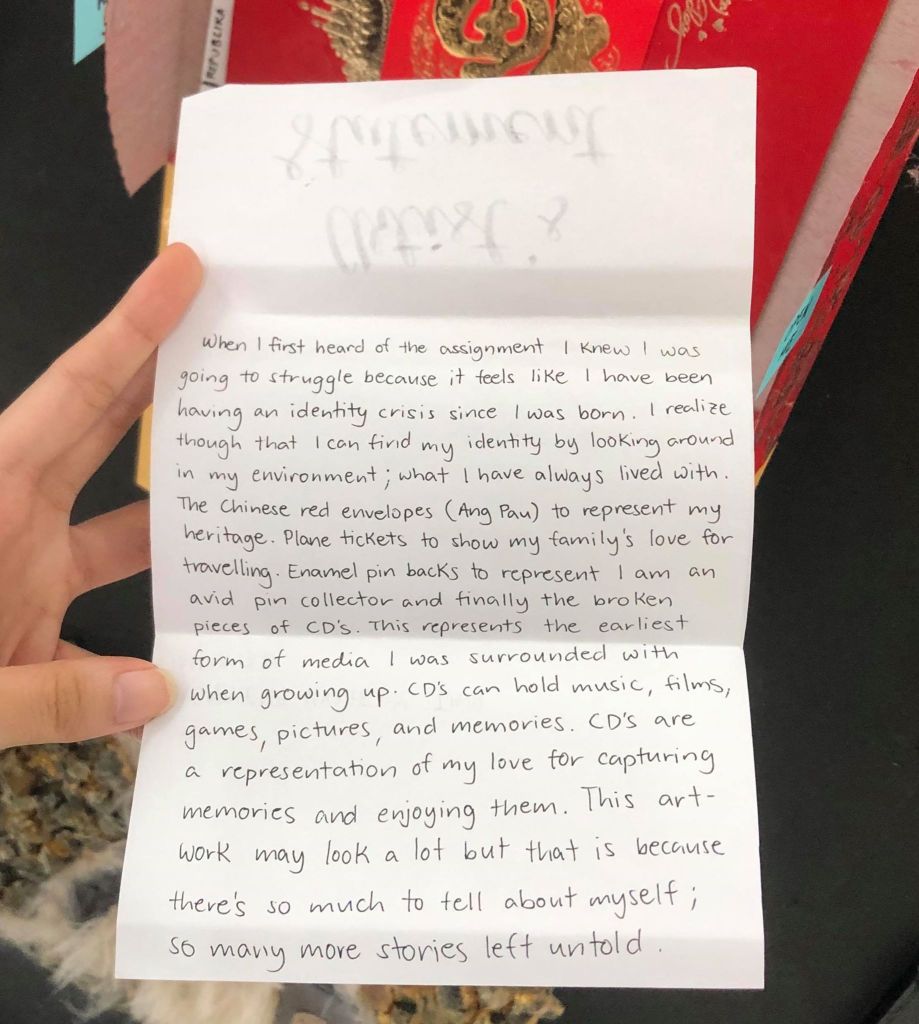
If there is one thing that I believe in, its signs and fate. Call me a romantic or whatnot, but it’s something that has always managed to get me by whenever I’m stuck somewhere. Though it doesn’t really have to do anything with the exhibit or anything, I like to believe that I came across that piece first for a reason.
First is that he/she mentioned about the identity crisis she has been experiencing since she was younger made her realize how she was going to struggle with the project. This is something that I deeply sympathize with. Knowing myself, it would take me a hundred years before I could decide who I think I am for sure. But at the end of the letter, this is what the artist said: “This artwork may look a lot, but that is because there is so much to tell about myself; so many more stories left untold.”
The development from the first to the last line resonates with me a lot. From being unsure of what to do due to a long-running identity crisis to finally realizing what they are made up of and what they have to offer is a character development I didn’t expect to witness in just a short letter. It’s something that I would read a whole novel about, except it’s just a brief letter from an artist to its viewers.
I went around the exhibit multiple times, coming across different artworks that usually came in triptychs, and most of them were interesting. There was this piece inspired by the Japanese art tradition of Kintsugi, wherein broken pieces of glass are brought together through mixing it with gold. There was also a resemblance of tower, with each level corresponding to the artist’s interests. The ones I enjoyed the most were the artworks that made use of flowers, but that’s just a personal thing as I’ve always loved the concept of blooming into something greater.
However, even as I went around and observed the pieces multiple times, even reading some of the descriptions repeatedly in hopes of connecting with it, there wasn’t another artwork that resonated with me as much as the very first one I saw. Maybe it was unintentional or maybe it was designed that way, but it felt like it was personally meant for me to read. It felt like the letter was written for me to come across. Perhaps it was the letter that elevated my connection to the piece, but nonetheless it still made it my favorite.
The things we take in consciously and actively take part in contribute to who we are as a person. Though it may not explain fully our identity, it is still a building block that can make us say that we are who we are now. From childhood up to where we are now, the little things that we stuck with us along the way can tell stories about ourselves. And maybe in that way, we get to know ourselves a little more better.
If I weren’t where I am right now, where would I be? That is the one question I always find myself asking. What if I got out of bed a minute earlier? What if I said yes to an invitation I denied instead? What if I chose differently? And the list of what if’s just keeps going on and on. Maybe I would be a millionaire right now, but then maybe things might have turned out for the worse. There is no way of knowing how things would have turned out for sure. The only thing you can do is guess, and yet I always find myself dwelling on these decisions. Am I wasting just wasting time or will this help me out in the future? Who knows. But if there is one thing I’ve learned, it is that for every choice you make, a different set of paths open up for you.
Do you ever get bored and scroll through random videos on Youtube, and then you suddenly find yourself on the weird side of youtube? One minute you’re watching your favorite artist’s funny moments and then the next you’re deep into unsolved murder mysteries at 3am? That was the case for me back in junior high when I discovered the concept of the butterfly effect. The concept states that a tiny step done right now could eventually lead to drastic results in the future. Given my tendency to overthink and dwell on the past, the video had a great impact and spoke to me on a personal level.
At the time I came across that video, I was still deciding on what career path to pursue. I’ve been confused all my life as to what I wanted to become or do when I grow older. I had, and still have, a keen interest in fashion ever since I was a child. For as long as I can remember, I wanted to work in that field. I knew what I wanted but I didn’t know what I wanted to be. Not only that, but I also had to consider the practicality and financial aspect of what I was going to pursue. Will the job eventually pay the bills? Or am I just going to gamble on a career path? Again with the never-ending questions to myself. To pursue what I love or to pursue something more pragmatic, a decision students like me usually face.
In the end, I chose to pursue humanities. It’s not a field I can say I’m completely confident in, but it’s a place where bits of my interests meet. Reading is one of the hobbies I’ve had ever since I was young; and subconsciously, I’ve always enjoyed imagining and writing different scenarios and stories. And plus, history and geography used to be my favorite subjects back in grade school. Where else can you find all of these than in the field of humanities, right? And so I decided to explore my path and see where it would take me.
But what I chose for my career path isn’t the entirety of my point. Rather, this one decision was the main event that made me realize that the world runs on choices. Had I taken a chance on pursuing fashion instead, I wouldn’t be writing this essay right now. I could be pulling all-nighters trying to stitch up one dress, or I could be drawing sketches of my future collections. Or maybe I’d be realizing that it wasn’t for me after all. But if it weren’t for that decision, I wouldn’t have met the people I have right now, and I wouldn’t have learned all the things I’ve gained from studying humanities. My point is, this one small choice I made largely affected the life I have right now.
Like a domino effect, the results of our choices can also influence our surroundings as well. For example, whether you choose to compliment a person or not can make or break someone’s day. I remember doubting my work and rarely showing it to people, but there was this one time I decided to show a story that I wrote to my friend to help me figure out a good title. I wasn’t expecting any feedback, but I remember him saying that it was very well-written and that I should take up a writing course. Of course I still don’t think my talents are up to par, but that honest reaction sparked my motivation up high and made me want to work more. If that one little compliment gave me a lot of boost, what more can those little things do on a larger scale? Maybe a little nudge can actually be a large push for some people.
On a wider scale, our small decisions not only can affect another individual, but it can also trigger events that are out of our hands. A modern example can be the huge Hong Kong protests against the extradition law in 2019, which actually started with a woman cheating on a man. Long story short, the man murdered his girlfriend in foreign land (Taiwan) and went back home (Hong Kong) where the government could not do anything due to the lack of said law. Who would have thought that adultery could lead to citizens risking their lives for their rights. That the root cause of a massive protest was actually just a cheating girlfriend. Let that sink in. Now you see how big of a difference this one small event made? A personal dispute turned into a nationwide crisis.
The world is a never-ending cycle of decisions to make, whether it’s deciding where to eat for lunch or making a deal for the nation. Likewise, these outcomes are non-linear. One decision can lead to another, but that doesn’t mean it is set on one path and one path only. The choices that we make all lead to different directions; and for every decision made opens another set of choices, a new set of possibilities.
“Mas masarap kumain ‘pag may kasama,” as the Filipino saying goes. My school’s foundation week was supposed to be celebrated during the last week of January. Unfortunately, Taal Volcano surprisingly erupted, and so the school had put the safety of the people first. But even though activities were postponed, my most awaited part of the celebration remained: the food park. It’s better to eat when you’re with someone, and such is the case for me and my friends. Exploring the food park is our most awaited activity every school celebration.
The clock struck 12’o’clock, and so lunchtime began. One of my friends, Loujane Alhumayed, invited us to go downstairs to check out the food park. The rest of my friends, Pat Campos and Hannah Sorrera, immediately agreed and went on to get their wallets. We were by the door when we saw Pat removing her jacket. Didn’t want the canteen smell to stick, she said. We followed her lead and started removing our sweaters as well. Once we’re all set, we headed out straight and waited for the elevator down.
The elevator opens, the sight of the stalls and the smell of the food welcomes us. We roam around to check out the various selections, feeling out what type of food we want to eat. As we walked around, we saw familiar stalls that we’ve seen from the past food bazaars. There was the Hottu Doggu, which from the name, serves freshly grilled hot dogs. There was the usual Takoyaki stand, as well as the Scramble vendor. We went around and saw that there’s also a stall that sells kpop merch. Almost walking the full circle, most of the stalls were familiar.
Loujane headed to her staple food park item– lemonade. I remember the first time we tried the lemonade from Coolava. It was during the sports fest celebration last year; and as usual, we were walking around checking the food stalls. The lemonade stand immediately caught our eye. Everyday for the week, we tried a different flavor, varying from lychee lemon to berry lemon. Ever since then, lemonade has become a staple for us to buy.
I heard Pat call out my name excitedly and looked at the direction of where she was pointing at. There I saw a new addition to the food selection called Avocadoria, an Avocado-flavored dessert shop. I’ve first tried it through my mom, who is a big fan of avocadoes. I remember trying it for the first time and immediately telling Pat about how good it was. Needless to say, we had our fair share of avocado ice cream.
As we received the ice cream, we sat down to wait for the rest of our friends. Loujane returned with her lemonade, while Hannah returned with cookies from a new stall called TigerCookies. She came back as if she discovered gold, saying the cookies are delicious. Each of us took a small bite out of the chocolate chip cookie, and it certainly did not disappoint. The impact of the cookies were clearly strong, as even after the week ended, one of my friends still kept thinking about it and eventually ordered online.
When we finished buying what we wanted to buy, we returned to our classroom. The first thing that we did when we got back was spray a ton of perfume on us, hopefully eliminating the smell of the canteen that stuck to us. We sat down and ate the food that we bought, talking about whatever we could think about. We continued to laugh at silly videos and converse about pop culture until we didn’t realize lunch was over. Indeed food does taste better when you’re eating with the people you love.
“‘Uy, may food park nanaman,” My classmates repeatedly keep saying. Supposedly, iACADEMY’s foundation week was to be celebrated on the dates January 27-31, as the occasion is usually commemorated on the same month. Game changers were looking forward to this event, however, due to the surprising eruption of Taal Volcano, the celebration was unfortunately postponed for the safety of students and faculty alike. But even though the events and activities were put on hold, there was a saving grace that remained that week– the food park. “Tara, food park tayo,” My friends and I said to each other. Just like that, our week was automatically made better.
The clock strikes 12’o’clock, lunchtime has begun. One of my friends, Loujane Alhumayed (17), invites us to go downstairs to check out the food park. The rest of my friends, Pat Campos (17) and Hannah Sorrera (18), immediately agreed and went on to get their wallets.
“I’ll remove my sweater,” said Pat. We follow her lead and remove our sweaters as well, knowing the smell of the cafeteria will stick to it once we return. Once we’re all set, we head out straight downstairs. We checked to see if there were any elevators going down, or else we’ll take the stairs, much to their dismay. Luckily, there was.
The elevator opens, the sight of the stalls and the smell of the food welcomes us. We roam around to check out the various selections, feeling out what type of food we want to eat. As we walk around, we saw familiar stalls that we see every food bazaar. There was the Hottu Doggu, which from the name, freshly grilled hot dogs. There was the usual Takoyaki stand, as well as the Scramble vendor. Loujane headed to her staple food park item– lemonade, which can be found at the stall called Coolava. Interestingly enough, they don’t just make regular lemonade. They mix a bunch of flavors, like lychee and peach, with the lemonade to create a refreshing burst of flavor. I’d usually go buy one, but there was a new stall that caught my eye.
“Bea, look oh!” my friend said excitedly. I looked at the direction of where she was pointing and saw a new addition to the food selection– Avocadoria, a shop that sells Avocado-flavored desserts. We rush to the stall, eager to buy their avocado ice cream. Beside Avocadoria was also a new stall that we hadn’t tried called Puesto, a Thai stall that sells pad thai.
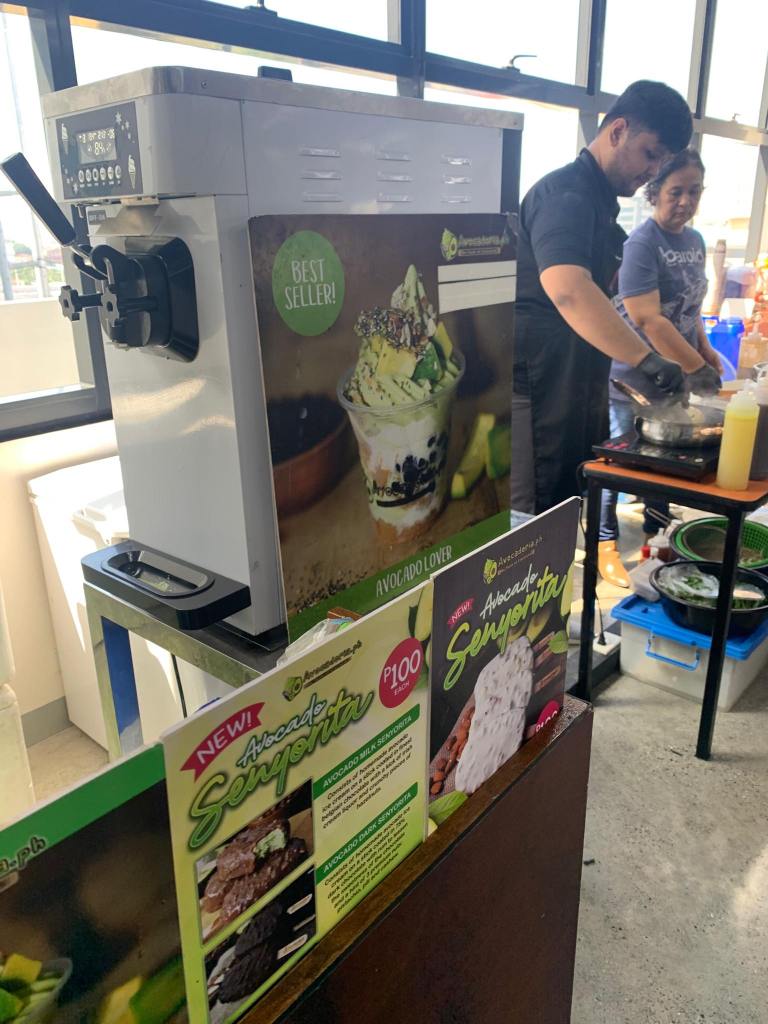
As we receive the ice cream, we sat down to wait for the rest of our friends. Loujane returned with her go-to lemonade, while Hannah returned as if she discovered gold. “These cookies are so good, I swear,” she said. Each of us takes a small bite out of the chocolate chip cookie, and it certainly did not disappoint. We asked her where she got it from, and she pointed at the new stall called Tiger Cookies, a stall that sells freshly baked goods. We checked it out and saw that they sell different types of cookies, like oreo and chocolate chip, as well as graham balls. Besides those stalls, there wasn’t anything new. There was a shop that sells kpop merch, the stall that sells Korean rice cakes, and the soft-serve shop.
When we finished buying what we wanted to buy, we returned to our classroom. The first thing that we did when we got back was spray a ton of perfume on us, hopefully eliminating the smell of the canteen that stuck to us. We proceed to eat what we bought, contented with what we found at the food park.
This is an example post, originally published as part of Blogging University. Enroll in one of our ten programs, and start your blog right.
You’re going to publish a post today. Don’t worry about how your blog looks. Don’t worry if you haven’t given it a name yet, or you’re feeling overwhelmed. Just click the “New Post” button, and tell us why you’re here.
Why do this?
The post can be short or long, a personal intro to your life or a bloggy mission statement, a manifesto for the future or a simple outline of your the types of things you hope to publish.
To help you get started, here are a few questions:
You’re not locked into any of this; one of the wonderful things about blogs is how they constantly evolve as we learn, grow, and interact with one another — but it’s good to know where and why you started, and articulating your goals may just give you a few other post ideas.
Can’t think how to get started? Just write the first thing that pops into your head. Anne Lamott, author of a book on writing we love, says that you need to give yourself permission to write a “crappy first draft”. Anne makes a great point — just start writing, and worry about editing it later.
When you’re ready to publish, give your post three to five tags that describe your blog’s focus — writing, photography, fiction, parenting, food, cars, movies, sports, whatever. These tags will help others who care about your topics find you in the Reader. Make sure one of the tags is “zerotohero,” so other new bloggers can find you, too.

 Ysabela Meets World